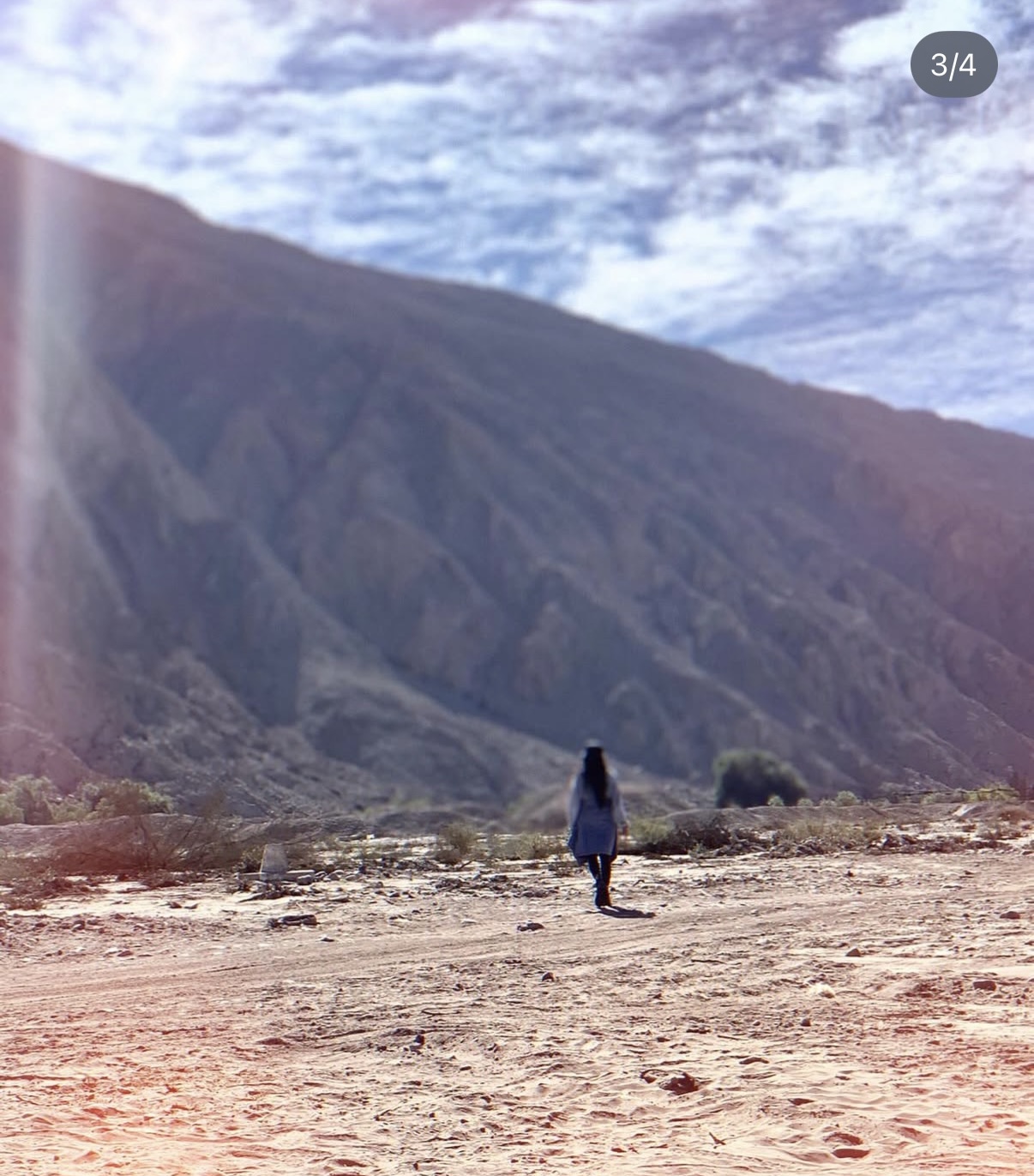
On getting to know someone after they've gone
Most of us meet the people we love properly at their funeral.
You know the scene. Up the back, in the good shoes that pinch, holding a program with their face on the front, smiling at some joke you'll never know about. And then someone you've never met in your life stands up and tells a story, and you're sitting there thinking wait, what? I didn't know that about her. I didn't know he did that.
A friend said something to me recently that I haven't been able to put down. He spent years with someone he loved, actual years, and he feels like he barely knew them until after they died.
I've been chewing on that ever since. On the bus, in the shower, at 2am.
Because I think it's true for most of us. We just don't say it.
While they're here, they're just there. Mum. Dad. Your brother. Your oldest friend. We know them by the part they play in our lives. The one who drives. The one who worries. The one who says the exact same thing every Christmas (you know the one).
We love the part.
We rarely meet the person playing it.
And here's the bit nobody tells you. That's not a failure. It's almost how it's meant to work. While we need someone, we can't really see them. We see what we need them to be. The safe one, the strict one, the one who should have known better. We hang our hopes and our hurts on them like coats on a hook.
Then they die, and the hook is gone, and all those coats fall to the floor. And for the first time, there they are. The whole of them. Their own fears and longings and secret little dreams. A whole life we were only ever a slice of.
Why we don't ask
It's not that we don't care. Nobody showed us how.
Asking your mum what she wanted to be before she had you feels weird. Asking your dad what scares him feels like stepping over some invisible line. And asking anyone what they'd want at the end of their life? Feels like you're wishing it on them.
So we talk about the footy. The weather. What's for dinner. Year after year after year.
Then someone gets sick and everything speeds up. Scans, appointments, medication charts, a car park that costs a fortune, everyone busy and everyone kind and everyone working so hard to keep them here. Which is good. It is. But somewhere between the car park and the ward, the real conversations get squeezed out.
There's never a good time.
Until there's no time.
Let me be blunt about one thing. Nobody else is going to ask for you. Not the specialist. Not the nurse on the night shift. Not the funeral director. They're all doing their jobs, and their jobs aren't this. If the question gets asked, it'll be because someone in the family was brave enough to ask it.
None of this is anyone's fault, really. It's just how we've built things. Somewhere along the way we decided death was the opposite of life, so we tucked it out of sight. Dying moved out of the bedroom and into the hospital. The stories moved out of the kitchen and into the eulogy.
We learnt to wait.
But death isn't the opposite of life. It's part of its shape. A river isn't ruined by reaching the sea. That's where it was heading the whole time.
And when we refuse to look at the end, we don't protect the middle.
We just sleep through it.
Without words
Even at the very end, something still gets said.
My friend told me about the last time he was with them. A hospital room. Machines humming. That fluorescent light that makes everyone look a bit grey. The kind of place where it's hard to feel anything human.
They couldn't speak anymore.
But they looked at him.
Steady.
While he held their hands.
He called it an energy transfer. Something passing between them, no words needed.
I believe him. Completely.
I've worked in care for most of my life, and I've sat with people on some of their hardest days. It's never the big moments that stay with me. It's the small ones. A hand held a little longer than it needed to be. A look across a room that said more than a whole conversation could.
Near the end, a lot of us stop speaking in sentences. We go back to the older language. A look. A squeeze. A face turned toward the window. Hands reaching for something in the air that nobody else can see. Talk of packing a bag, or catching a train, or a door that needs opening.
We call it confusion. And sometimes it is.
But the deepest part of us never spoke in sentences anyway. It speaks in pictures. Journeys and doorways and crossings, the same images that turn up in our dreams and in fairy tales and in stories people have been telling around fires forever.
Maybe that's the soul packing its bag.
In the only language it ever had.
So if you're ever sitting by a bed and there's nothing left to say, say nothing. Hold the hand. Stay. And if they start talking about a trip, don't correct them. Ask where they're going. Ask who's coming. You might learn more in that conversation than in the last ten years of Sunday lunches.
That's not wasted time.
That might be the whole conversation.
The hunt
This weekend in Chile, where I was born, it was Día de Todos los Santos. Families went to the cemetery with flowers, and some brought buckets and cloths too, and they scrubbed the headstones and pulled the weeds and swapped the faded plastic flowers for bright new ones.
And then they sat.
They talked to the dead, and to each other about the dead, and somebody always told a story the others hadn't heard before.
Some cultures never stopped talking to their dead.
They just gave it a day, and brought a bucket.
My friend has been doing his own version for years, minus the bucket. He called it an Easter egg hunt. Looking for all the pieces they left in everyone else. A story from an old mate. A side of them he never got to see, kept safe in someone else this whole time.
I love that he called it an egg. It's one of the oldest symbols we've got. Something that looks still and closed and finished, with life folded up inside. People all over the world have told stories about the whole world hatching from one.
Because people don't leave all at once.
They scatter.
A bit with the friend from forty years ago. A bit with the neighbour who used to borrow the ladder. A bit in a photo in a shoebox that nobody's looked at properly.
Fair warning though. The pieces won't always match. Their old workmate will tell you they were the funniest person in the room. Their sister will tell you they never laughed. Both can be true. A person isn't one story. They were a slightly different human with everyone they ever met. The hunt doesn't give you the real version. It gives you all of them.
And a bit of them is in you.
That's the part that really got me. The hunt had him finding pieces of himself too. A habit. A turn of phrase. The thing that cracks him up. And suddenly knowing exactly where it came from.
I don't think that's an accident.
The people we love don't just leave memories. They move in. They live on in us, with their own voices and moods, pulling up a chair in our chest. Their unfinished business. Their unlived dreams. The things they never said out loud. Whatever they didn't get to live, we often end up carrying around for them.
Sometimes it shows up as a restlessness we can't explain. A pull toward a life we didn't choose and can't shake. So if you've ever found yourself chasing something that doesn't quite feel like yours, it's worth asking. Is this my dream? Or one they left behind?
Grief, I reckon, is partly the slow work of meeting them in there. Sitting down together and sorting it all out. What's theirs. What's ours. What to keep. What to put down. What to finish for them, and what was never ours to finish in the first place.
And look, not every egg is one you want.
A temper you recognise. A coldness. A way of leaving the room when things get hard. Those count too. We can't become whole by only keeping the shiny bits.
What we refuse to look at doesn't go anywhere.
It just waits in the dark.
And usually, it comes out sideways, at the worst possible moment, at someone who doesn't deserve it.
Better to pick it up on purpose.
So the hunt isn't really about the past. It's about who you're becoming. They're gone, and somehow they're still helping you grow into yourself.
And for what it's worth, there's no finish line. People talk about closure like it's a door that clicks shut. It isn't. The hunt can go on for years, and that doesn't mean you're stuck. It means the relationship is still alive. It's just changed address.
My own version
With my dad it was different.
We never had the closeness I always hoped for. And he died before we got the chance to find it. So my grief was for something that never quite existed.
So I'm on a hunt too.
Mine just has fewer eggs.
But I've found one I didn't expect. The way I love has been shaped by that absence. I lean in. I stay. I want people to be seen and heard, especially at the end.
Maybe that's the egg.
Not him, exactly.
What the missing made in me.
My friend had so much time and still ran out. I had so little and ran out too. Different roads. Same question waiting at the end of both.
What would I have said?
The missed chances
He said one more thing. No matter how hard we try, we'll always see missed opportunities. It's up to us whether that makes us love deeper or not.
That's the whole thing, really.
You will have regrets. Everyone does. Nobody gets to the end of someone's life having said and asked everything. There's no version of this where you get it all right, and anyone who tells you otherwise hasn't lost anyone yet.
Here's something worth knowing, too. Regret looks at the past with information you didn't have back then. You didn't know it was the last ordinary Tuesday. You didn't know there wasn't more time. You made the best call you could with what you knew. That's not a failure. That's just being human, and not being able to see the future.
Regret can go two ways. It can harden you. Teach you to hold back, keep people at arm's length, decide it's safer to care a little less.
Or it can soften you.
Crack something open.
So you love the people still here a bit more out loud.
You don't get to choose whether you'll have regrets.
You do get some say in what they become.
And sometimes regret is just love with nowhere to go.
So give it somewhere.
A small ritual
You don't need a cemetery or a public holiday for this. Just a quiet half hour and a cup of tea.
Pull up two chairs. One for you, one for them.
Light a candle if you like. Put something of theirs on the empty chair. A photo. Their favourite mug. A scarf that still smells a bit like them. Their reading glasses.
Then ask them one question out loud. The one you never got to ask.
And sit.
Don't rush to fill the silence (I know, it's hard). You won't get an answer the usual way. But the part of them that lives in you might stir. Notice what comes. A memory. An image. A word. A name. A feeling somewhere in your chest.
Write it down, even if it makes no sense yet. Images have their own timing.
And if a name comes, that's your next egg.
Go and ask them.
Some ways to go hunting
Write to someone who knew them before you did. A first friend, an old workmate, a cousin. Don't ask "how are you going". Ask for one story you've probably never heard.
If there's a funeral or memorial coming up, put out a jar and some cards. Ask people to write down one memory, especially the ones nobody would say into a microphone. Read them later, slowly.
Go back through the photos and look at the edges, not the middle. Who else is in the shot? What's on the table? Where were they? Ask about the ones you can't explain.
Notice what you've inherited. Write a list. Keep what serves you. Thank them for the rest, and put it down.
And if your people are still here
Don't wait for the funeral.
Ask them what they were like at your age. What they're proud of. What they'd do differently. What they dreamed of that never happened.
Ask for the story you've heard a hundred times, and this time listen like it's brand new. Record it on your phone if they'll let you. Trust me, one day you'll want their voice more than you can say.
And ask the big one. What would they want at the end of their life? Where would they want to be? Who would they want close? What would they want to hear, or wear, or hold?
It'll feel awkward. Ask anyway.
Awkward is a tiny price. Most people have been carrying their answers around for years, quietly waiting for someone brave enough to ask.
We never get the whole of anyone.
Not even the living.
But there's more of them out there than you think.
In other people.
In you.
Still unfolding.
Keep looking.
And if you're on a hunt of your own and you'd like some company, I'm here.
Carolina
carolina x